Ashwagandha - Withania Somnifera
Ashwagandha Benefits And Uses: A Complete Guide To This Ayurvedic Herb
Ashwagandha Is One Of The Best-Known Herbs In Ayurveda And Has Attracted Growing Interest In Modern Herbal Wellness Products. Its Roots Have Traditionally Been Used In Herbal Preparations, While Contemporary Research Has Explored Certain Extracts For Their Possible Effects On Stress And Sleep.
Known Botanically As Withania somnifera, Ashwagandha Belongs To The Nightshade Family. Although It Has A Long History Of Traditional Use, Its Benefits Should Be Understood In The Context Of Available Scientific Evidence And Important Safety Considerations.
A. Introduction To Ashwagandha
Ashwagandha Is A Medicinal Herb Traditionally Used In Ayurveda, The Traditional Indian System Of Health And Wellness. It Is Commonly Described As A Rejuvenating Or Restorative Herb In Traditional Practice.
Today, Ashwagandha Is Available In Several Forms, Including Dried Root Powder, Capsules, Tablets, And Concentrated Extracts. These Products Are Commonly Marketed For Stress Management, Relaxation, Sleep Support, And General Wellbeing.
However, Traditional Use Does Not Automatically Establish Medical Effectiveness. Scientific Findings Depend On The Specific Preparation Studied, Its Composition, The Duration Of Use, And The People Participating In The Research.
B. Botanical Information About Ashwagandha
Botanical Detail
Information
Common Name
Ashwagandha, Indian Ginseng, Winter Cherry
Scientific Name
Withania somnifera (L.) Dunal
Botanical Family
Solanaceae, Also Known As The Nightshade Family
Other Names And Regional Names
Asgandh, Asvagandha, Indian Ginseng, Winter Cherry
Parts Of The Plant Used
Primarily The Root; Leaves Are Used In Certain Preparations
Origin And Distribution
Native To Parts Of Asia And Africa; Cultivated In India And Other Suitable Regions
| Botanical Detail | Information |
|---|---|
| Common Name | Ashwagandha, Indian Ginseng, Winter Cherry |
| Scientific Name | Withania somnifera (L.) Dunal |
| Botanical Family | Solanaceae, Also Known As The Nightshade Family |
| Other Names And Regional Names | Asgandh, Asvagandha, Indian Ginseng, Winter Cherry |
| Parts Of The Plant Used | Primarily The Root; Leaves Are Used In Certain Preparations |
| Origin And Distribution | Native To Parts Of Asia And Africa; Cultivated In India And Other Suitable Regions |
Common Name
Ashwagandha Is The Most Widely Used Common Name For This Plant. It Is Also Known As Indian Ginseng And Winter Cherry, Although Indian Ginseng Is A Common Name Rather Than A Botanical Classification.
Ashwagandha Is The Most Widely Used Common Name For This Plant. It Is Also Known As Indian Ginseng And Winter Cherry, Although Indian Ginseng Is A Common Name Rather Than A Botanical Classification.
Scientific Name
Withania somnifera (L.) Dunal
Withania somnifera (L.) Dunal
Botanical Family
Solanaceae, Also Known As The Nightshade Family.
Solanaceae, Also Known As The Nightshade Family.
Other Names And Regional Names
Ashwagandha Is Used In Different Linguistic And Traditional Contexts. In India, It Is Also Known By Regional Names Such As Asgandh And Asvagandha. Indian Ginseng And Winter Cherry Are Common English Names.
Ashwagandha Is Used In Different Linguistic And Traditional Contexts. In India, It Is Also Known By Regional Names Such As Asgandh And Asvagandha. Indian Ginseng And Winter Cherry Are Common English Names.
Parts Of The Plant Used
-
Root: The Principal Plant Part Used In Many Traditional Ayurvedic Preparations And Commercial Supplements.
-
Leaves: Used In Certain Traditional Preparations And Some Modern Extracts.
-
Other Plant Parts: Their Use Varies By Preparation And Tradition And Should Not Be Assumed To Be Interchangeable With Root Products.
-
Root: The Principal Plant Part Used In Many Traditional Ayurvedic Preparations And Commercial Supplements.
-
Leaves: Used In Certain Traditional Preparations And Some Modern Extracts.
-
Other Plant Parts: Their Use Varies By Preparation And Tradition And Should Not Be Assumed To Be Interchangeable With Root Products.
Origin And Distribution
Ashwagandha Is Native To Parts Of Asia And Africa And Grows In Regions Of India And Other Areas With Suitable Climates. It Is A Small Perennial Or Evergreen Shrub Commonly Associated With Relatively Dry Growing Conditions.
The Plant Is Cultivated And Collected For Use In Traditional Herbal Preparations And The Herbal Products Industry.
C. Description And Characteristics Of Ashwagandha
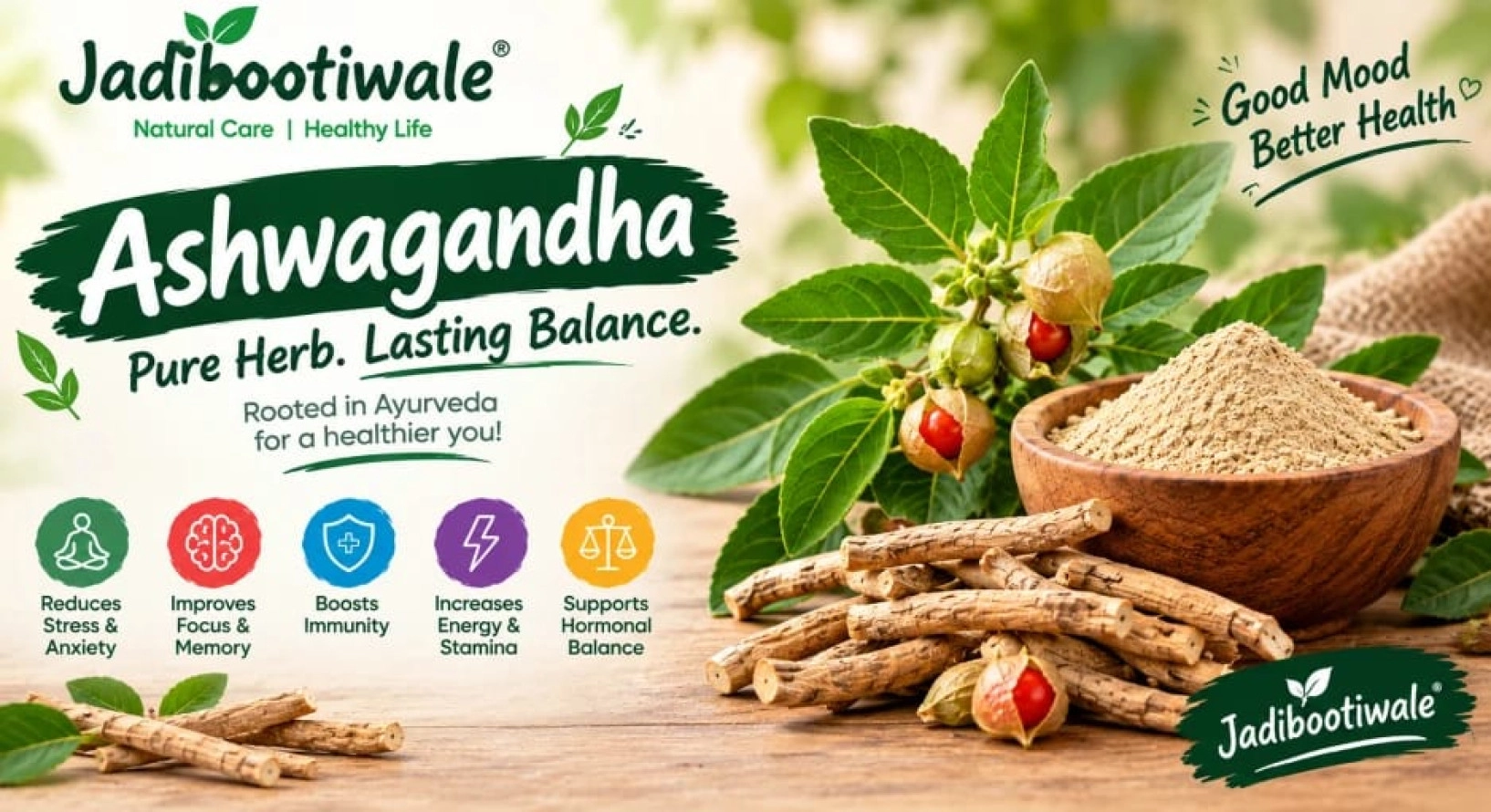
Ashwagandha Is A Small Shrub With Branching Stems And Green Leaves. It Produces Small Flowers And Develops Orange-Red Berries Enclosed By A Papery Covering.
Its Roots Are Generally Tan To Light Brown Externally And Pale Internally. Dried Roots Are Processed Into Powders Or Extracts For Use In Herbal Products.
Aroma And Taste
Dried Ashwagandha Root Powder Typically Has An Earthy Aroma And A Strong, Somewhat Bitter Or Astringent Taste. The Exact Aroma, Colour, And Flavour Can Vary Depending On The Plant Material, Processing Method, And Storage Conditions.
Dried Ashwagandha Root Powder Typically Has An Earthy Aroma And A Strong, Somewhat Bitter Or Astringent Taste. The Exact Aroma, Colour, And Flavour Can Vary Depending On The Plant Material, Processing Method, And Storage Conditions.
Identifying Features
Important Botanical Characteristics Include:
-
A Branching Shrub With Green Leaves.
-
Small Flowers And Orange-Red Berries.
-
A Developed Root System Used In Many Herbal Preparations.
-
Dried Root Material That May Be Cut, Powdered, Or Processed Into An Extract.
Appearance Alone Cannot Establish Purity Or Confirm The Identity Of A Commercial Powder. Appropriate Botanical Identification And Quality Testing Are Important When Evaluating Raw Material.
D. Nutritional Value And Chemical Composition
Ashwagandha Is Primarily Used As A Medicinal Herb Rather Than As A Conventional Food Ingredient. Its Importance In Herbal Products Comes Mainly From Its Naturally Occurring Chemical Constituents Rather Than From A Standard Nutritional Profile.
Ashwagandha Is Primarily Used As A Medicinal Herb Rather Than As A Conventional Food Ingredient. Its Importance In Herbal Products Comes Mainly From Its Naturally Occurring Chemical Constituents Rather Than From A Standard Nutritional Profile.
Withanolides
Withanolides Are A Group Of Naturally Occurring Steroidal Lactones Found In Ashwagandha. They Are Among The Best-Known Chemical Constituents Investigated In Laboratory And Pharmacological Research.
Different Extracts Can Contain Different Amounts And Profiles Of These Compounds. A Product's Withanolide Content Depends On Its Plant Parts, Extraction Method, And Manufacturing Specifications.
Other Naturally Occurring Constituents
Ashwagandha Contains A Range Of Plant Compounds, Including Alkaloids And Other Phytochemicals. Their Amounts Vary According To The Plant Material And Preparation.
Ashwagandha Contains A Range Of Plant Compounds, Including Alkaloids And Other Phytochemicals. Their Amounts Vary According To The Plant Material And Preparation.
Is Ashwagandha A Source Of Vitamins And Minerals?
Ashwagandha Supplements Should Not Automatically Be Regarded As Significant Sources Of Particular Vitamins, Minerals, Protein, Or Dietary Fibre. Such Claims Require Reliable Analytical Data For The Specific Product.
For This Reason, A Nutrition Table Should Only Be Published When Supported By Appropriate Laboratory Results Or A Trustworthy Source Relevant To The Actual Product.
E. Traditional Uses Of Ashwagandha
Ashwagandha Has A Long History Of Use In Ayurvedic Herbal Practice. Traditionally, It Has Been Included In Preparations Intended To Support Vitality, Strength, Resilience, And General Wellbeing.
Common Traditional Applications Include:
-
Restorative Herbal Preparations: Used In Traditional Wellness Routines Intended To Support Vitality.
-
Stress And Relaxation Practices: Traditionally Associated With Helping The Body Cope With Everyday Strain.
-
Sleep-Related Preparations: Used In Some Traditional Approaches To Promote Rest.
-
General Wellness: Included In Various Herbal Formulations And Tonics.
-
Combined Herbal Preparations: Sometimes Blended With Other Herbs As Part Of Traditional Formulations.
These Applications Describe Traditional Practices Rather Than Proof That Ashwagandha Can Treat A Medical Condition. Traditional Formulations May Also Differ Substantially From The Extracts Examined In Modern Research.
F. Potential Benefits Of Ashwagandha: What Does Research Say?
Scientific Interest In Ashwagandha Has Focused Particularly On Stress And Sleep. Although Some Clinical Studies Have Reported Encouraging Findings, The Evidence Remains Limited By Small Study Populations, Relatively Short Durations, And Differences Between Preparations.
Scientific Interest In Ashwagandha Has Focused Particularly On Stress And Sleep. Although Some Clinical Studies Have Reported Encouraging Findings, The Evidence Remains Limited By Small Study Populations, Relatively Short Durations, And Differences Between Preparations.
1. Stress Management
Several Small Clinical Trials Suggest That Some Ashwagandha Extracts May Help Reduce Perceived Stress. Some Studies Have Also Reported Changes In Cortisol, A Hormone Involved In The Body's Stress Response.
These Results Are Promising But Do Not Establish That Every Ashwagandha Product Has The Same Effect. More Research Is Needed To Determine Which Preparations Are Useful And How Consistent The Effects Are.
2. Sleep Quality
Some Studies Suggest That Specific Ashwagandha Extracts May Modestly Improve Sleep Quality, Sleep Duration, Or The Time Taken To Fall Asleep.
However, Studies Have Used Different Extracts And Doses. The Evidence Is Not Sufficient To Guarantee A Benefit For Every Individual Or To Recommend Ashwagandha As A Replacement For Appropriate Care For Persistent Sleep Problems.
3. Anxiety-Related Symptoms
Research Has Explored Ashwagandha In People Experiencing Stress And Anxiety-Related Symptoms. Findings From Some Trials Are Encouraging, But The Evidence For Treating Anxiety Disorders Remains Unclear.
Ashwagandha Should Not Replace Prescribed Treatment Or Professional Mental Health Care.
Research Has Explored Ashwagandha In People Experiencing Stress And Anxiety-Related Symptoms. Findings From Some Trials Are Encouraging, But The Evidence For Treating Anxiety Disorders Remains Unclear.
Ashwagandha Should Not Replace Prescribed Treatment Or Professional Mental Health Care.
4. Physical Performance And Testosterone
Ashwagandha Is Also Marketed For Exercise Performance, Strength, Male Fertility, And Testosterone Support. Some Limited Research Has Reported Changes In Selected Measures, But Evidence Is Insufficient To Establish Broad Benefits Across Healthy Populations.
It Should Not Be Presented As A Proven Treatment For Infertility, Low Testosterone, Or Other Medical Conditions.
What Are The Limitations Of The Evidence?
-
Many Studies Involve Relatively Small Numbers Of Participants.
-
Research Often Examines Particular Extracts Rather Than All Forms Of Ashwagandha.
-
Studies Frequently Last Only Several Weeks Or A Few Months.
-
Long-Term Effectiveness And Safety Remain Uncertain.
Overall, Some Preparations May Offer Benefits For Stress And Sleep, But Further High-Quality Research Is Needed. These Findings Are Not Evidence That Ashwagandha Cures Or Prevents Disease.
-
Many Studies Involve Relatively Small Numbers Of Participants.
-
Research Often Examines Particular Extracts Rather Than All Forms Of Ashwagandha.
-
Studies Frequently Last Only Several Weeks Or A Few Months.
-
Long-Term Effectiveness And Safety Remain Uncertain.
Overall, Some Preparations May Offer Benefits For Stress And Sleep, But Further High-Quality Research Is Needed. These Findings Are Not Evidence That Ashwagandha Cures Or Prevents Disease.
G. Common Uses And Applications Of Ashwagandha
Herbal Supplements
Ashwagandha Is Commonly Sold As Capsules, Tablets, Root Powder, And Concentrated Extracts. Some Formulations Contain Ashwagandha Alone, While Others Combine It With Additional Herbs Or Ingredients.
Ashwagandha Is Commonly Sold As Capsules, Tablets, Root Powder, And Concentrated Extracts. Some Formulations Contain Ashwagandha Alone, While Others Combine It With Additional Herbs Or Ingredients.
Traditional Ayurvedic Preparations
Ashwagandha Root Is Used In Traditional Herbal Formulations, Including Powders And Compound Preparations. The Appropriate Form Depends On The Particular Traditional Practice And The Intended Use.
Ashwagandha Root Is Used In Traditional Herbal Formulations, Including Powders And Compound Preparations. The Appropriate Form Depends On The Particular Traditional Practice And The Intended Use.
Personal-Care Products
Ashwagandha May Appear In Certain Cosmetic And Personal-Care Formulations. Its Inclusion Does Not Automatically Demonstrate A Specific Cosmetic Benefit, And Topical Products Should Only Be Used According To Their Intended Purpose And Label Instructions.
Ashwagandha May Appear In Certain Cosmetic And Personal-Care Formulations. Its Inclusion Does Not Automatically Demonstrate A Specific Cosmetic Benefit, And Topical Products Should Only Be Used According To Their Intended Purpose And Label Instructions.
Commercial Herbal Products
Manufacturers May Use Ashwagandha As An Ingredient In Wellness Supplements And Herbal Formulations. Product Quality Depends On Correct Identification, Suitable Processing, Ingredient Transparency, And Appropriate Testing.
Ashwagandha Is Not Generally Used As An Everyday Culinary Herb In The Same Way As Common Cooking Spices.
H. How To Use Ashwagandha
Ashwagandha Products Are Available In Several Forms, And Each May Have Different Preparation Instructions.
Ashwagandha Products Are Available In Several Forms, And Each May Have Different Preparation Instructions.
Ashwagandha Root Powder
Root Powder Is Used In Some Traditional Preparations. If A Product Is Intended For Oral Use, Follow Its Label And Obtain Professional Advice When Needed. Do Not Assume That Instructions For One Powder Apply To A Concentrated Extract.
Root Powder Is Used In Some Traditional Preparations. If A Product Is Intended For Oral Use, Follow Its Label And Obtain Professional Advice When Needed. Do Not Assume That Instructions For One Powder Apply To A Concentrated Extract.
Capsules And Tablets
These Provide A Measured Amount Of The Ingredients Specified By The Manufacturer. Check The Serving Information, Ingredient List, Warnings, And Recommended Directions On The Packaging.
These Provide A Measured Amount Of The Ingredients Specified By The Manufacturer. Check The Serving Information, Ingredient List, Warnings, And Recommended Directions On The Packaging.
Standardized Extracts
Extracts Are Manufactured Using Specific Processing Methods And May Be Standardized To A Stated Amount Of Selected Constituents, Such As Withanolides. Standardization Can Help Describe Composition But Does Not By Itself Prove Effectiveness Or Safety.
Extracts Are Manufactured Using Specific Processing Methods And May Be Standardized To A Stated Amount Of Selected Constituents, Such As Withanolides. Standardization Can Help Describe Composition But Does Not By Itself Prove Effectiveness Or Safety.
How Much Ashwagandha Should You Take?
There Is No Single Dosage That Applies To Every Ashwagandha Product. Clinical Studies Have Used Different Preparations And Amounts, So Study Results Should Not Be Converted Directly Into Personal Dosing Advice.
Follow The Instructions For The Specific Product And Consult A Qualified Healthcare Professional Before Use, Particularly If You Take Medication Or Have A Medical Condition.
Do Not Consume Products Labelled For External Use.
I. Possible Side Effects And Precautions
Ashwagandha Is Not Suitable For Everyone. Safety Is Particularly Important Because Supplements Can Differ In Composition And Strength.
Ashwagandha Is Not Suitable For Everyone. Safety Is Particularly Important Because Supplements Can Differ In Composition And Strength.
Common Side Effects
Reported Side Effects Include:
-
Upset Stomach.
-
Nausea.
-
Loose Stools Or Diarrhoea.
-
Drowsiness.
-
Vomiting In Some Cases.
Some People May Experience Other Unwanted Effects.
Reported Side Effects Include:
-
Upset Stomach.
-
Nausea.
-
Loose Stools Or Diarrhoea.
-
Drowsiness.
-
Vomiting In Some Cases.
Some People May Experience Other Unwanted Effects.
Liver Safety
Rare Cases Of Liver Injury Have Been Associated With Ashwagandha Supplements. Stop Taking The Product And Seek Prompt Medical Advice If You Develop Yellowing Of The Skin Or Eyes, Dark Urine, Unusual Itching, Or Persistent Abdominal Discomfort.
Rare Cases Of Liver Injury Have Been Associated With Ashwagandha Supplements. Stop Taking The Product And Seek Prompt Medical Advice If You Develop Yellowing Of The Skin Or Eyes, Dark Urine, Unusual Itching, Or Persistent Abdominal Discomfort.
Thyroid Conditions
Ashwagandha May Affect Thyroid Hormone Levels. People With Thyroid Disorders And Those Taking Thyroid Medication Should Avoid Self-Treatment And Discuss Potential Risks With A Healthcare Professional.
Ashwagandha May Affect Thyroid Hormone Levels. People With Thyroid Disorders And Those Taking Thyroid Medication Should Avoid Self-Treatment And Discuss Potential Risks With A Healthcare Professional.
Medication Interactions
Ashwagandha May Interact With Certain Medicines, Including:
-
Medicines For Diabetes.
-
Medicines For High Blood Pressure.
-
Sedatives And Other Medicines That Cause Drowsiness.
-
Immunosuppressant Medicines.
-
Thyroid Hormone Medication.
-
Some Anti-Seizure Medicines.
Ask A Doctor Or Pharmacist To Review Potential Interactions Before Using Ashwagandha With Medication.
Pregnancy And Breastfeeding
Ashwagandha Should Be Avoided During Pregnancy And Is Not Recommended While Breastfeeding Because Safety Has Not Been Adequately Established.
Ashwagandha Should Be Avoided During Pregnancy And Is Not Recommended While Breastfeeding Because Safety Has Not Been Adequately Established.
Other Precautions
People With Autoimmune Conditions, People With Hormone-Sensitive Prostate Cancer, And Those Preparing For Surgery Should Avoid Using Ashwagandha Unless A Qualified Healthcare Professional Specifically Advises Otherwise.
Safety In Children Has Not Been Adequately Established For Routine Supplement Use.
Important: Evidence On Use Beyond Approximately Three Months Is Limited. Do Not Assume That A Product Is Safe For Long-Term Use Simply Because It Is Herbal Or Traditionally Used.
J. How To Identify And Choose Quality Ashwagandha Products
Choosing A Quality Product Requires More Than Checking Its Colour Or Price.
Choosing A Quality Product Requires More Than Checking Its Colour Or Price.
Check The Ingredient Label
Look For:
-
The Botanical Name Withania somnifera.
-
The Plant Part Used, Such As Root Or Root And Leaf.
-
The Product Form, Such As Powder Or Extract.
-
A Clear Ingredient List And Serving Instructions.
-
Manufacturer Details, Batch Identification, And Expiry Information.
Look For:
-
The Botanical Name Withania somnifera.
-
The Plant Part Used, Such As Root Or Root And Leaf.
-
The Product Form, Such As Powder Or Extract.
-
A Clear Ingredient List And Serving Instructions.
-
Manufacturer Details, Batch Identification, And Expiry Information.
Look For Appropriate Quality Testing
Where Available, Choose Products Supported By Credible Quality Testing For Identity, Purity, And Relevant Contaminants. Testing May Include Checks For Heavy Metals, Microbial Contamination, Pesticides, And Undeclared Ingredients As Appropriate To The Product.
Do Not Claim That A Product Is Certified, Organic, Or Laboratory Tested Unless The Relevant Documentation Supports That Claim.
Understand Extract Standardization
Some Products Declare A Standardized Withanolide Content. Check Whether The Label Explains The Extract Composition And Whether The Manufacturer Provides Supporting Specifications.
A Higher Stated Concentration Does Not Automatically Mean That A Product Is Better Or Safer.
Some Products Declare A Standardized Withanolide Content. Check Whether The Label Explains The Extract Composition And Whether The Manufacturer Provides Supporting Specifications.
A Higher Stated Concentration Does Not Automatically Mean That A Product Is Better Or Safer.
Assess Packaging And Supplier Reliability
Prefer Sealed Packaging With Clear Labelling, Traceable Batch Information, And Suitable Storage Instructions. Buy From A Reliable Supplier That Can Provide Product Information When Requested.
Prefer Sealed Packaging With Clear Labelling, Traceable Batch Information, And Suitable Storage Instructions. Buy From A Reliable Supplier That Can Provide Product Information When Requested.
K. Storage And Shelf Life Of Ashwagandha
Proper Storage Helps Protect Ashwagandha Products From Moisture, Heat, And Contamination.
Proper Storage Helps Protect Ashwagandha Products From Moisture, Heat, And Contamination.
Storage Guidelines
-
Keep The Product In Its Original, Tightly Closed Packaging.
-
Store It In A Cool, Dry Place Away From Direct Sunlight.
-
Avoid Introducing Moisture Into Powders Or Containers.
-
Keep The Product Away From Children And Pets.
-
Follow Any Special Storage Instructions Provided By The Manufacturer.
-
Keep The Product In Its Original, Tightly Closed Packaging.
-
Store It In A Cool, Dry Place Away From Direct Sunlight.
-
Avoid Introducing Moisture Into Powders Or Containers.
-
Keep The Product Away From Children And Pets.
-
Follow Any Special Storage Instructions Provided By The Manufacturer.
How Long Does Ashwagandha Last?
Shelf Life Depends On The Product Form, Processing Method, Packaging, And Storage Conditions. Powder, Capsules, And Extracts May Have Different Stability Characteristics.
Use The Expiry Or Best-Before Date Stated On The Product Packaging. Do Not Assign A Universal Shelf Life To All Ashwagandha Products Without Product-Specific Stability Information.
Discard Products With Damaged Packaging, Signs Of Moisture Contamination, Or Unusual Changes In Appearance Or Smell.
L. Frequently Asked Questions About Ashwagandha
The Following Questions Address Common Concerns About Ashwagandha, Its Traditional Uses, Available Evidence, And Safe Selection.
The Following Questions Address Common Concerns About Ashwagandha, Its Traditional Uses, Available Evidence, And Safe Selection.
1. What Is Ashwagandha?
Ashwagandha Is A Shrub Known Scientifically As Withania somnifera. Its Root Is Widely Used In Traditional Ayurvedic Preparations And Modern Herbal Supplements.
Ashwagandha Is A Shrub Known Scientifically As Withania somnifera. Its Root Is Widely Used In Traditional Ayurvedic Preparations And Modern Herbal Supplements.
2. What Are The Potential Benefits Of Ashwagandha?
Some Studies Suggest That Particular Ashwagandha Extracts May Help Reduce Perceived Stress And Modestly Improve Sleep. More Research Is Needed To Confirm Their Effectiveness And Long-Term Safety.
Some Studies Suggest That Particular Ashwagandha Extracts May Help Reduce Perceived Stress And Modestly Improve Sleep. More Research Is Needed To Confirm Their Effectiveness And Long-Term Safety.
3. What Is The Scientific Name Of Ashwagandha?
The Scientific Name Is Withania somnifera. It Belongs To The Solanaceae Family, Commonly Known As The Nightshade Family.
The Scientific Name Is Withania somnifera. It Belongs To The Solanaceae Family, Commonly Known As The Nightshade Family.
4. Which Part Of Ashwagandha Is Commonly Used?
The Root Is The Most Commonly Used Part In Many Traditional Preparations And Commercial Supplements. Some Products Contain Leaf Extracts Or Combinations Of Root And Leaf.
The Root Is The Most Commonly Used Part In Many Traditional Preparations And Commercial Supplements. Some Products Contain Leaf Extracts Or Combinations Of Root And Leaf.
5. How Is Ashwagandha Available In The Market?
Ashwagandha Is Available As Root Powder, Capsules, Tablets, And Concentrated Extracts. The Ingredients And Strength Can Vary Between Products.
Ashwagandha Is Available As Root Powder, Capsules, Tablets, And Concentrated Extracts. The Ingredients And Strength Can Vary Between Products.
6. Is Ashwagandha Scientifically Proven To Reduce Stress?
Some Small Clinical Trials Suggest That Certain Preparations May Reduce Perceived Stress. However, The Evidence Is Not Conclusive, And Results From One Extract Cannot Automatically Be Applied To All Products.
Some Small Clinical Trials Suggest That Certain Preparations May Reduce Perceived Stress. However, The Evidence Is Not Conclusive, And Results From One Extract Cannot Automatically Be Applied To All Products.
7. Can Ashwagandha Improve Sleep?
Some Research Suggests Modest Improvements In Sleep Quality And Duration With Certain Extracts. More Research Is Needed, And Persistent Sleep Problems Should Be Discussed With A Healthcare Professional.
Some Research Suggests Modest Improvements In Sleep Quality And Duration With Certain Extracts. More Research Is Needed, And Persistent Sleep Problems Should Be Discussed With A Healthcare Professional.
8. What Are The Possible Side Effects Of Ashwagandha?
Possible Side Effects Include Stomach Upset, Nausea, Diarrhoea, And Drowsiness. Rare Cases Of Liver Injury Have Also Been Reported In Association With Ashwagandha Supplements.
Possible Side Effects Include Stomach Upset, Nausea, Diarrhoea, And Drowsiness. Rare Cases Of Liver Injury Have Also Been Reported In Association With Ashwagandha Supplements.
9. Who Should Avoid Ashwagandha?
Ashwagandha Should Be Avoided During Pregnancy And Is Not Recommended While Breastfeeding. People With Thyroid Or Autoimmune Conditions, Those Taking Certain Medications, And People With Hormone-Sensitive Prostate Cancer Should Seek Medical Guidance Or Avoid Use As Advised By A Healthcare Professional.
Ashwagandha Should Be Avoided During Pregnancy And Is Not Recommended While Breastfeeding. People With Thyroid Or Autoimmune Conditions, Those Taking Certain Medications, And People With Hormone-Sensitive Prostate Cancer Should Seek Medical Guidance Or Avoid Use As Advised By A Healthcare Professional.
10. How Should Ashwagandha Products Be Stored?
Store Ashwagandha Products In Sealed Packaging In A Cool And Dry Place Away From Direct Sunlight And Moisture. Follow The Manufacturer's Storage Instructions And Expiry Date.
Store Ashwagandha Products In Sealed Packaging In A Cool And Dry Place Away From Direct Sunlight And Moisture. Follow The Manufacturer's Storage Instructions And Expiry Date.
M. Conclusion
Ashwagandha Is An Important Herb In Traditional Ayurvedic Practice And Is Widely Used In Modern Herbal Supplements. Its Botanical Identity, Root-Based Preparations, And Naturally Occurring Withanolides Have Made It A Subject Of Continuing Scientific Interest.
Research Suggests That Some Specific Preparations May Help With Perceived Stress And Sleep, But The Evidence Remains Limited And Cannot Be Applied Equally To Every Product. Potential Side Effects, Rare Reports Of Liver Injury, Thyroid Effects, Medication Interactions, And Pregnancy-Related Precautions Also Deserve Attention.
For Consumers And Herbal Product Businesses, The Best Approach Is To Prioritize Accurate Information, Transparent Product Labelling, Appropriate Quality Testing, And Responsible Use. Ashwagandha Should Be Presented As A Traditional Herb With Promising But Incomplete Evidence Rather Than As A Guaranteed Treatment For A Medical Condition.